


For many years I struggled to face a deep truth: my long-term marriage needed to end. I have prided myself on my ability to recycle and repair almost anything. Growing up in poverty, I learned how to reuse other people’s castoffs, whether that was clothing, furniture or even old cars. Over my lifetime this ability has been very valuable. I have redesigned draperies from estate sales, repainted old lamps with chipped plaster, and restrung broken necklaces. In addition, I have taken pride in repairing any relationship with frayed or tattered edges. Over the last five years I applied all these skills to our marriage: I tried to redesign it, mend the holes with a needle and thread, and restring our good memories. I must admit, this required all of my know-how and a significant amount of energy.
On a very deep level I fought against my inner knowing: our marriage was simply not repairable.
Last April, after living in California for twenty-six years, I packed-up my sewing kit and returned to Minnesota. While all of this has caused me to be reflective, there are other issues-larger than mine-that warrant attention. The recent earthquake and tsunami in Japan would be challenging enough, but the threat of nuclear exposure raises the bar on natural disasters and what we do and do not have control of, even with the best of plans.
Although I live a life that is socially and ecologically conscious, I have to ask myself: How do I partake in mending the world, when I wasn’t able to repair my own marriage?
I think of Japan, the war in Afghanistan, and our own fractured financial market. What is stunningly clear is the uncertainty in our personal lives becomes exasperated by world events. I continually have to stop and ask myself what are truly my personal issues, what belongs to global trauma, and where do these two intersect?
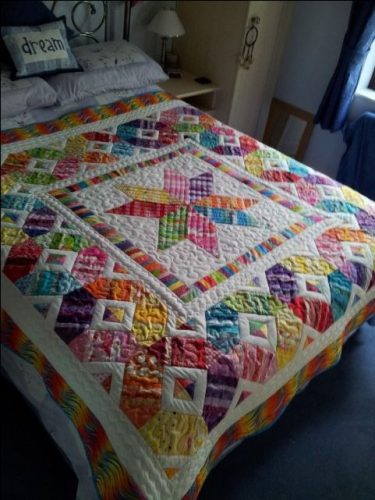
The image that comes to mind for me is a quilt. The quilts that I value most are the ones in which I see the story of my own life. I recognize my grandmother’s floral dress, the one she wore in the springtime, and my sister’s beloved blouse. Within the kaleidoscope pattern are my own memories, some which are happy and others that represent challenge and transition. Yet each piece of fabric is sewn end to end, bound together with thread. It is this imagery that honors my past and allows me to actually see myself as part of the whole. In addition, each quilt is sewn within the historical context of cultural change.
Being single for nearly a year, after having the security of a twenty-year marriage, has had its challenges. The last time I was single, I was twenty-nine years old, and e-mail didn’t even exist. The idea of internet dating would’ve been as futuristic as watching The Jetsons. Now, there are “manly” things that I am now responsible for, such as changing the oil in the car, the mysteries of house maintenance, and yard care.
On a deeper level, there are also aspects of vulnerability. Two weeks ago I drove myself to the Ortonville Hospital in the early morning hours to face a second foot surgery. The implications of what it means to be alone were very evident. Although I tend to avoid wallowing in self-pity, I certainly recognized this psychological landscape as one that would’ve warranted it. The winter morning was dark and cold, the calm, after our recent blizzard. As I made my way to the entrance of the hospital, I noticed someone walking toward me in the distance. I didn’t think anything of it. But then I heard a woman’s voice, and her arms began to wave at me with the enthusiasm of a child, “Edie, Edie, it’s me, Neva! I’m scrubbing in for your surgery, so you won’t be alone. You will have a friend with you.” Neva Foster is indeed a friend. She is a fellow artist in town, attends my dream analysis class, and is a highly competent nurse. My heart instantly filled, rimmed over, really.
As I was taken into the sterile, brightly lit surgery room, it became quickly evident that I was not alone. As promised, there was Neva, adorned in a robin’s blue surgery gown with a matching cap. But it was her million-dollar smile that made me realize, she too, is part of the fabric of my quilt.
I am-we are all-in an undulating cycle of being torn apart, sewn together, and mended to be made whole again. I treasure my quilt and its historical representation of not only my life but of the world. In the cold of the Minnesota winter, I wrap the quilt around myself. I am warmed by its imperfections and its beauty–but mostly–I’m grateful because it’s mine.